
How to Access Multiple LLMs Through a Single API Key in 2026
Stop juggling API keys across providers. Learn how to access GPT, Claude, Gemini, and more through one API key with setup steps & security tips.

Sohrab Hosseini
Co-founder (Orq.ai)
Key Takeaways
Managing multiple LLMs isn't the hard part. The harder part is maintaining the provider-specific code, scattered keys, and inconsistent fallback logic around them.
Unified keys win on speed. BYOK wins on governance. Most mature teams end up using both, defaulting to unified and moving specific workloads to BYOK as control needs grow.
A single API key doesn't remove complexity. It moves complexity out of application code and into a control layer where routing and cost decisions can actually be governed.
Bring LLM-powered apps from prototype to production
Discover a collaborative platform where teams work side-by-side to deliver LLM apps safely.






Managing multiple LLMs looks simple at first. Add a provider, store another API key, wire up a new SDK. Repeat as needed.
The complexity shows up later, when providers start to diverge.
API keys end up scattered across services and environments. Each provider behaves slightly differently. Retry logic, routing decisions, and cost tracking get implemented in multiple places.
We've found that managing multiple models isn't what slows teams down - maintaining everything around them is.
A unified API key solves this by introducing a single control point. Instead of maintaining separate provider integrations, you manage model access in one place.
In this guide, we’ll break down why this approach matters in practice and where it introduces trade-offs you need to account for.
Why you need one API key for multiple LLMs
Once you add more than one provider, the problem stops being model choice and becomes system design.
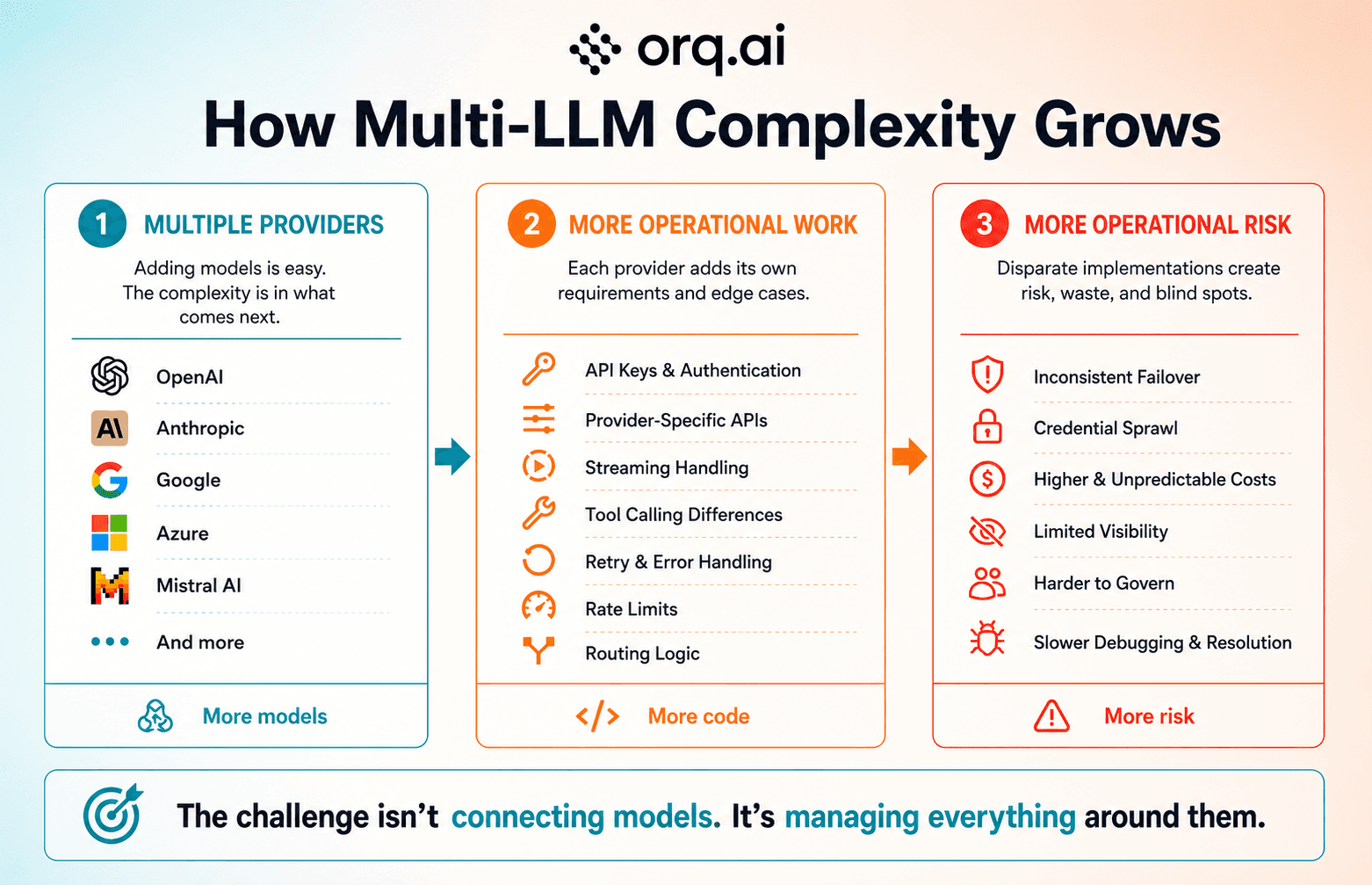
Provider differences add maintenance work that sits outside the product’s core logic.
The integration tax compounds
LLM APIs often look similar at first, but each one still needs its own handling in practice.
We rarely see integration logic stay in one place. It almost always spreads across services over time.
OpenAI, Anthropic, and Google all structure requests and responses differently. Streaming, tool calling, and error handling vary in subtle ways.
Supporting multiple providers means writing and maintaining provider-specific code paths, often with routing logic embedded directly in the application.
That cost compounds over time. Adding or switching models becomes a development task rather than a configuration change. Applications integrate once, and model selection moves out of code and into configuration.
Reliability depends on more than a single provider
Provider failures are rarely binary.
Requests get rate-limited, latency spikes, or specific regions degrade. Without a unified layer, fallback logic gets implemented inconsistently across services, if it exists at all.
A shared gateway gives every service the same failover rules. Traffic can shift between models without each application needing to handle those edge cases independently.
Credential sprawl becomes a security and governance issue
Multiple providers mean multiple API keys, often spread across various environments and developer machines.
As deployments grow, teams usually lose visibility into where provider credentials are actually being used.
Over time, it becomes difficult to track which key is used where and how usage maps to teams or workflows.
This creates both security risk and operational blind spots.
Choose between a unified key and BYOK
Once you centralize access through a gateway, the next decision is where provider credentials live.
This choice affects billing, control, and how tightly you stay coupled to individual providers.
Unified provider key
With a unified key, the gateway manages provider credentials on your behalf. Your application authenticates once, and the platform handles routing and provider interactions behind the scenes.
No provider accounts to manage and usage is consolidated into a single bill. The trade-off is that you rely on the gateway for visibility and control at the provider level.
In practice, this model is common for teams optimizing for speed and simplicity, especially early on.
BYOK (bring your own key)
With BYOK, you connect your own provider API keys to the gateway. The gateway still handles routing and orchestration, but billing and contracts remain with your provider accounts.
This gives you full visibility into provider usage and makes it easier to meet compliance requirements or maintain negotiated pricing. The trade-off is added operational overhead, since you’re still managing multiple provider relationships.
Most enterprise teams move toward this model as usage grows and governance requirements become stricter.
Which approach should you choose?
The right choice comes down to whether immediate simplicity or long-term control matters more right now.
Teams early in their AI adoption tend to start with a unified key. It removes setup friction and allows them to move quickly without managing multiple provider accounts.
We see this shift in practice as deployments mature. A recent survey found that 93% of enterprises exceeded their AI budgets.
Cost attribution, compliance, and vendor relationships start to matter more.
Most mature setups use both by defaulting to a unified key for speed and moving specific workloads to BYOK where visibility or governance matters.
Understand the types of single-API-key solutions
Single-key tools fall into a few distinct categories, and each serves a different need.
Managed AI gateways
These platforms act as a control layer on top of multiple providers.
This is typically the fastest path to production, especially when multiple teams are involved and consistency matters.
The trade-off is that you’re introducing a new layer into your stack, which needs to meet your performance and governance requirements.
Examples include Orq.ai, Portkey, and Helicone.
Self-hosted gateways
Self-hosted options give you similar capabilities, but your team owns the infrastructure.
This gives you full control over infrastructure and data flow, which is often required in regulated environments.
In return, your team owns scaling, updates, and reliability.
These setups tend to work best for teams that already have platform engineering capacity.
Examples include LiteLLM, Agenta, and self-hosted deployments of Cloudflare AI Gateway.
Aggregators
Aggregators optimize for breadth of access more than production control.
They expose a large number of models behind a single API, making it easy to experiment and switch providers quickly. However, they typically offer limited support for routing policies, governance, or production observability.
Examples include OpenRouter and Replicate.
Cloud-native platforms
Cloud providers offer their own abstraction layer over multiple models within their ecosystem. That approach is more relevant as AI stacks become more diverse. 81% of enterprises now use three or more generative AI models.
The main advantage is integration with existing infrastructure, identity, and billing. The limitation is scope. Model access and routing are tied to a single cloud, which can reduce flexibility if you want to stay provider-agnostic.
Examples include AWS Bedrock and Google Vertex AI.
How to migrate without breaking production
The smoothest migrations usually change traffic gradually, not architecture overnight.
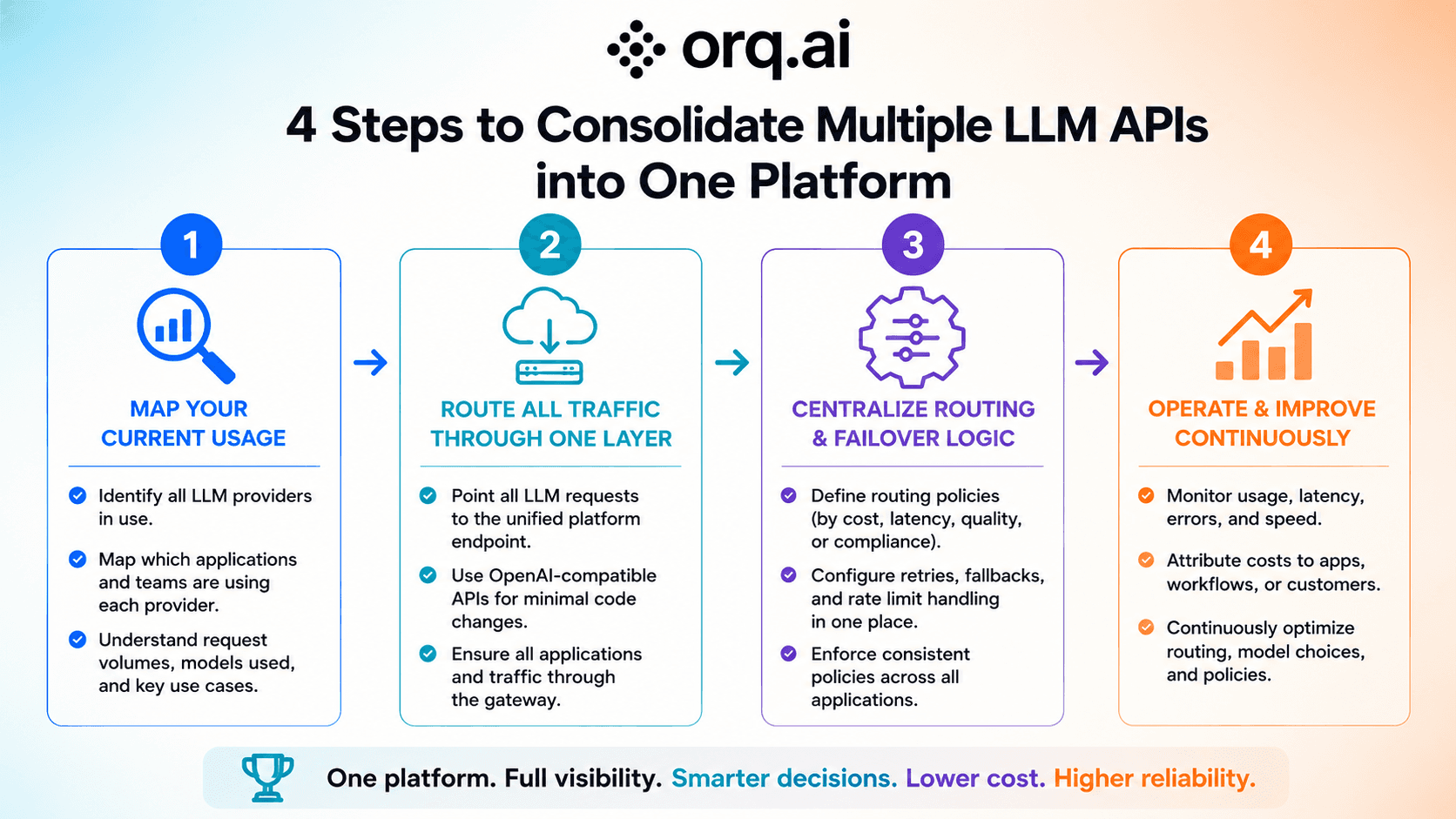
Most teams follow a similar pattern:
Audit what actually exists: Inventory every place models are called. This usually uncovers undocumented integrations and inconsistent usage patterns.
Run the gateway in parallel: Route a small portion of traffic through the gateway first. This exposes differences in latency, output, and failure behavior without risking the full system.
Compare behavior, not just success rates: Output format and tone can still break downstream logic.
Migrate gradually: Start with low-risk paths, then increase traffic incrementally. Avoid full cutovers unless the system is simple.
Keep a rollback path: Keep direct provider access until the gateway is fully stable.
Handled this way, migration becomes a controlled transition rather than a high-risk switch.
Centralize access, not complexity
A single API key changes where complexity lives.
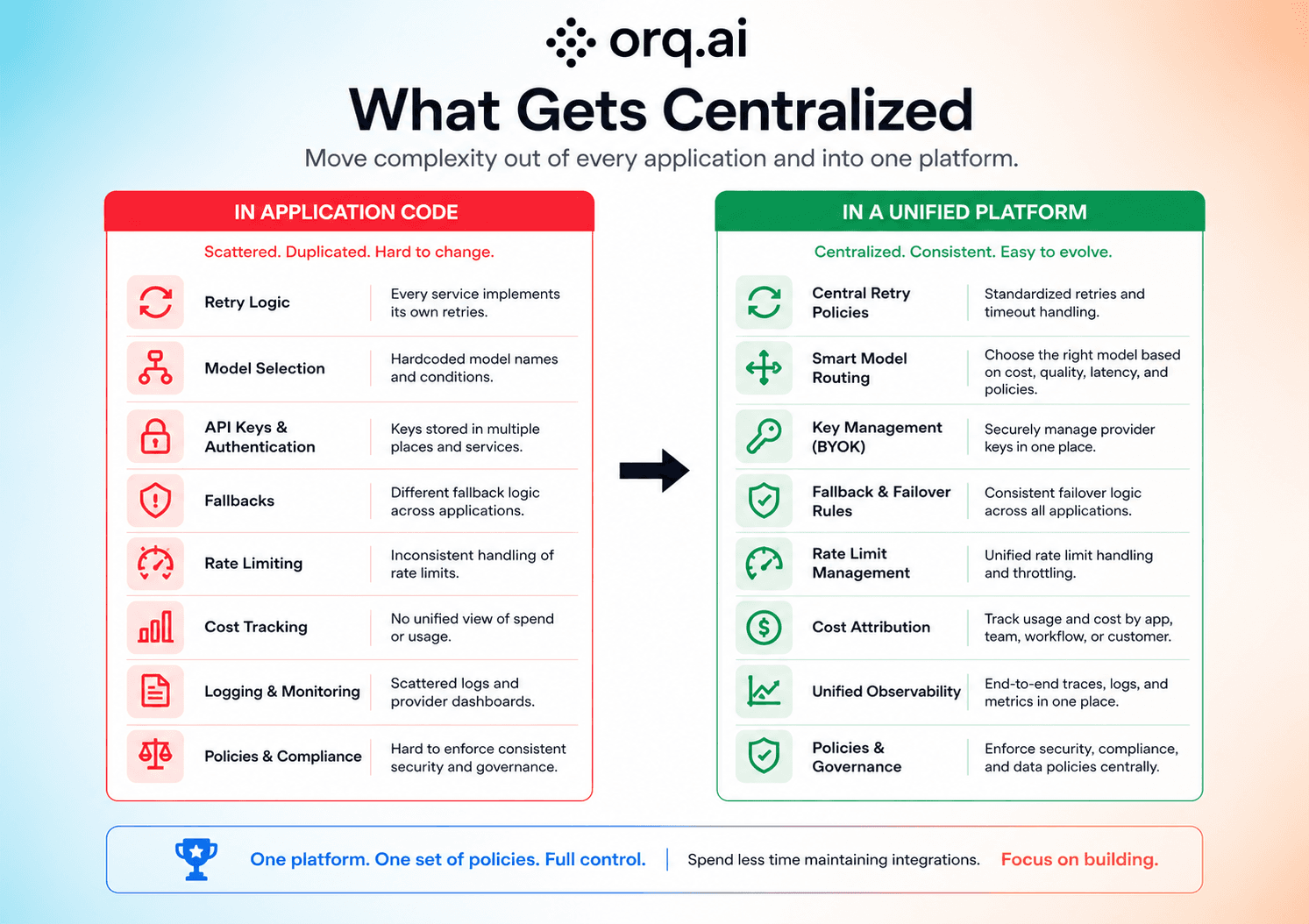
Without a control layer, multi-LLM setups push routing and cost decisions into application code.
The long-term value comes from continuously improving routing and governance, not simply connecting more models.
If model control is getting harder to maintain as your system grows, a platform like Orq.ai that combines routing, access, and governance is worth evaluating.
Book a demo and walk through your current setup with the Orq.ai team.
How much latency does a unified API key solution add?
A gateway introduces an additional network hop, typically measured in milliseconds. For most applications, this is negligible compared to model inference time.
Is using one API key for all LLMs secure?
It can improve security, but only if implemented correctly.
Centralizing access reduces credential sprawl, but it also concentrates risk. Strong setups rely on scoped keys, role-based access control, and enforced limits.
Can you self-host a single-API-key solution?
Yes. Self-hosted gateways give you full control over data flow, routing logic, and infrastructure.
This is often required for strict compliance or data residency requirements. The trade-off is ownership. Your team becomes responsible for scaling, reliability, and keeping up with provider changes.
How long does it take to migrate to a unified API key?
The integration itself is usually straightforward. In OpenAI-compatible setups, it often comes down to updating an endpoint and credentials.
The real effort is in everything around it. Removing hardcoded model logic, aligning retry behavior, and validating output consistency.

Sohrab Hosseini
Co-founder (Orq.ai)
About
Sohrab is one of the two co-founders at Orq.ai. Before founding Orq.ai, Sohrab led and grew different SaaS companies as COO/CTO and as a McKinsey associate.