
AI Gateway vs Traditional API Gateway: Key Differences
AI gateway vs traditional API gateway: how they differ, when to use each, and why AI workloads need purpose-built infrastructure. Side-by-side comparison.

Sohrab Hosseini
Co-founder (Orq.ai)
Bring LLM-powered apps from prototype to production
Discover a collaborative platform where teams work side-by-side to deliver LLM apps safely.






Every infrastructure layer exists because something became too painful to manage in application code.
API gateways solved that problem for web services.
AI gateways solve it for language models.
The difference isn't that AI applications call a different endpoint. It's that they behave differently after the request arrives. Costs fluctuate. Model quality changes. Providers fail in different ways.
At Orq.ai, we believe this is the most dangerous AI failure mode. The infrastructure looks healthy, so the decline in model behavior receives no operational urgency.
At that point, traditional API gateway patterns won’t be enough.
AI AI gateway vs traditional API gateway at a glance
The clearest difference is the type of traffic each layer understands.
Dimension | Traditional API gateway | AI gateway |
Primary role | Controls traffic between clients and application services | Controls traffic between applications and model providers |
Request model | Deterministic API calls with stable contracts | Probabilistic model requests with variable outputs |
Routing | Sends requests to a service based on path or method | Selects a model or provider according to policy |
Rate limits | Measures request volume | Measures token consumption |
Caching | Matches the exact request | Recognizes semantically similar prompts |
Security | Inspects headers and request metadata | Applies controls to prompt and response content |
Observability | Tracks latency, status codes, and failures | Tracks model behavior, token use, and routing outcomes |
Cost control | Treats requests as broadly comparable | Accounts for costs that vary by model and token volume |
Versioning | Manages API contract versions | Abstracts model and provider changes |
Streaming | Supports streaming as an additional capability | Treats token streaming as a core behavior |
Deployment point | Sits in front of backend services | Sits between application services and AI providers |
Traditional API gateways govern deterministic application traffic
Traditional API gateways work because the traffic they control is predictable enough to govern with fixed rules.
A client calls /orders/12345. The path identifies the service. The gateway checks access. And the response comes back with a familiar signal: success, failure, or timeout.
That contract is stable, so teams can build reliable controls around it.
In practice, this is exactly where traditional gateways are strongest. They give platform teams one place to enforce policies across a large API estate without pushing the same logic into every service.
Traditional gateways still do their original job well. AI traffic simply introduces decisions they were never designed to understand.
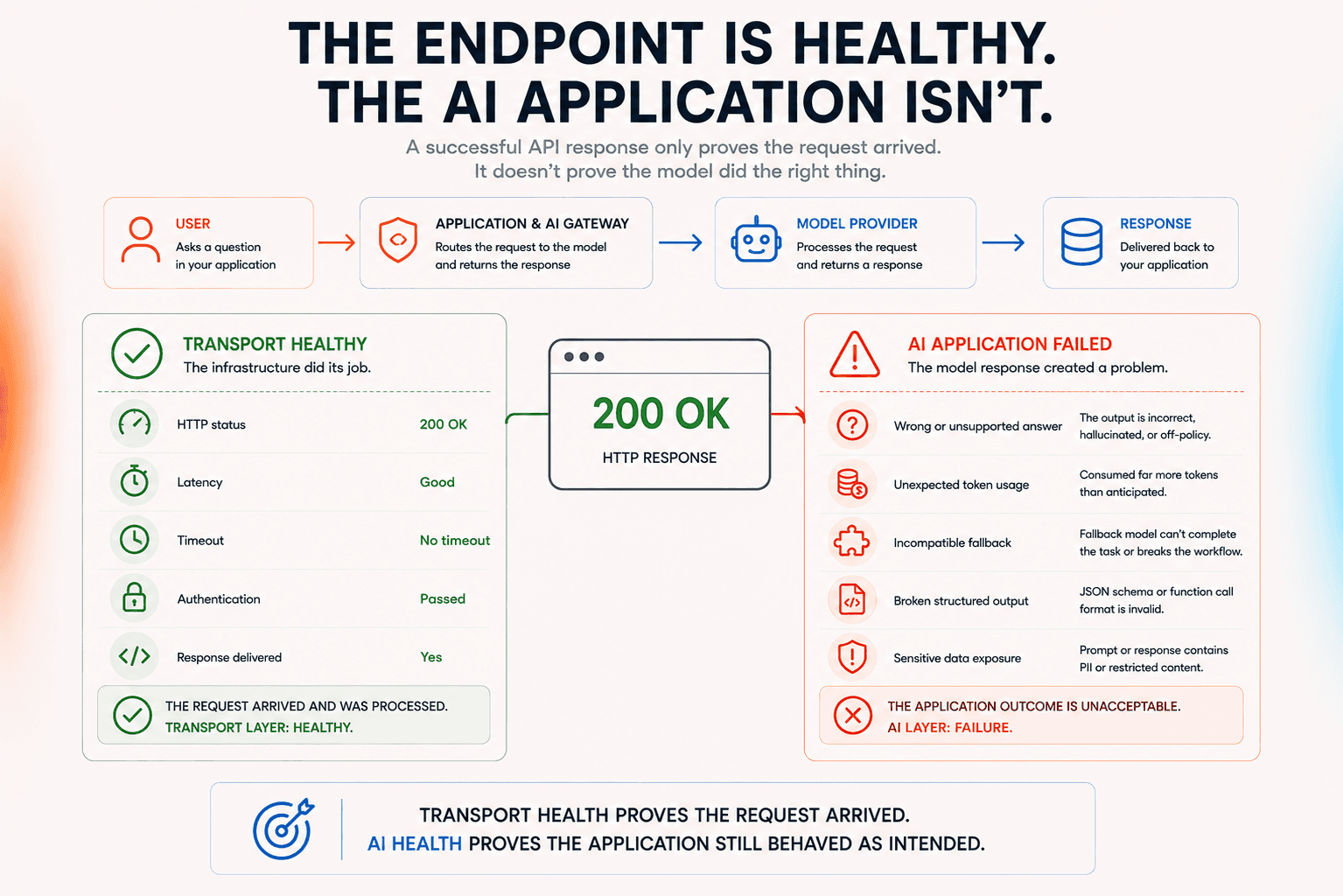
Our view is that transport health and AI health should be treated as separate operating signals. One proves the request arrived, the other proves the application still behaved as intended.
AI gateways govern probabilistic, token-based model traffic
AI gateways exist because a successful model call can still be an operational failure.
The request may return 200, consume far more tokens than expected, and produce an answer the application should never show. Traditional gateway signals confirm that traffic moved correctly. What they don’t explain is whether the model behaved well.
That difference changes the control layer. A purpose-built AI gateway can inspect the prompt, record the selected model, and attribute the cost created by the response.
It can also see when a provider failure triggers a fallback and whether that fallback is actually compatible with the request.
Consider a support assistant receiving two versions of the same question. A traditional cache treats them as separate requests because the text differs.
An AI gateway can recognize that the meaning is equivalent and reuse a previous response, reducing unnecessary model calls.
Traditional gateways can forward LLM traffic but can’t govern model behavior
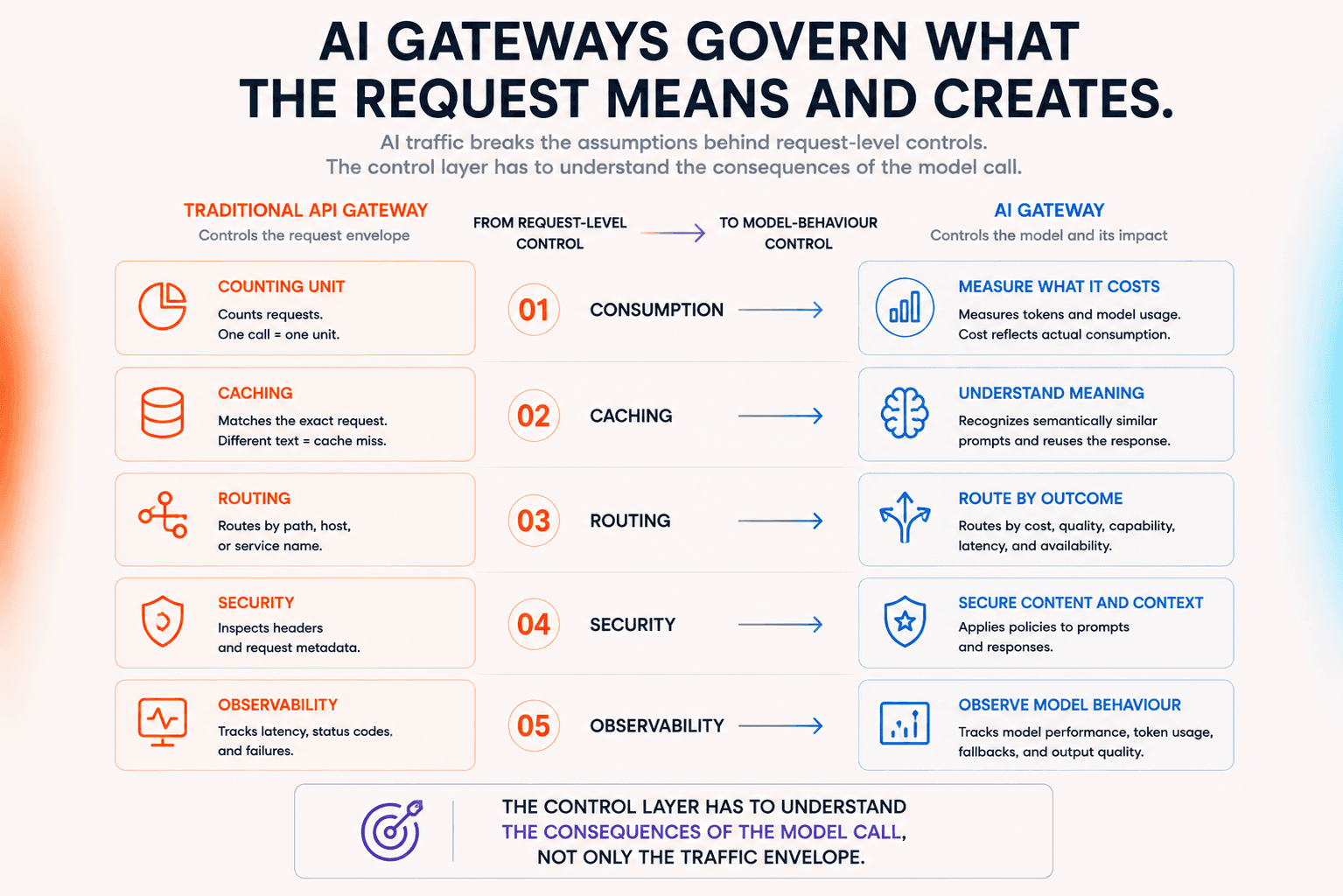
A traditional gateway can forward an LLM request and confirm that the endpoint responded. It can’t tell whether the selected model was appropriate or whether the call consumed far more budget than expected.
Once several applications share model infrastructure, those HTTP-level signals stop explaining what is happening inside the AI layer.
1: Token-aware controls govern AI spend
Request limits assume that calls to the same endpoint have roughly comparable costs. LLM traffic breaks that assumption.
We believe request volume is a weak control unit for model traffic. AI budgets should follow the consumption created by each workload, not the number of times an endpoint was called
A short classification request and a long document analysis may both count as one API call, even though one consumes a fraction of the tokens. AI gateways can apply limits to actual model usage, giving teams a way to control spend before an inefficient workflow creates a surprise invoice.
2: Semantic caching understands meaning, not text
Traditional caching looks for an exact match. Users rarely ask the same question in exactly the same words.
“What is the return policy?” and “How do returns work?” may require the same answer. A semantic cache can recognize that equivalence and reuse a previous response instead of paying for another model call. That makes caching useful for natural-language traffic rather than only identical requests.
3: Model routing protects reliability
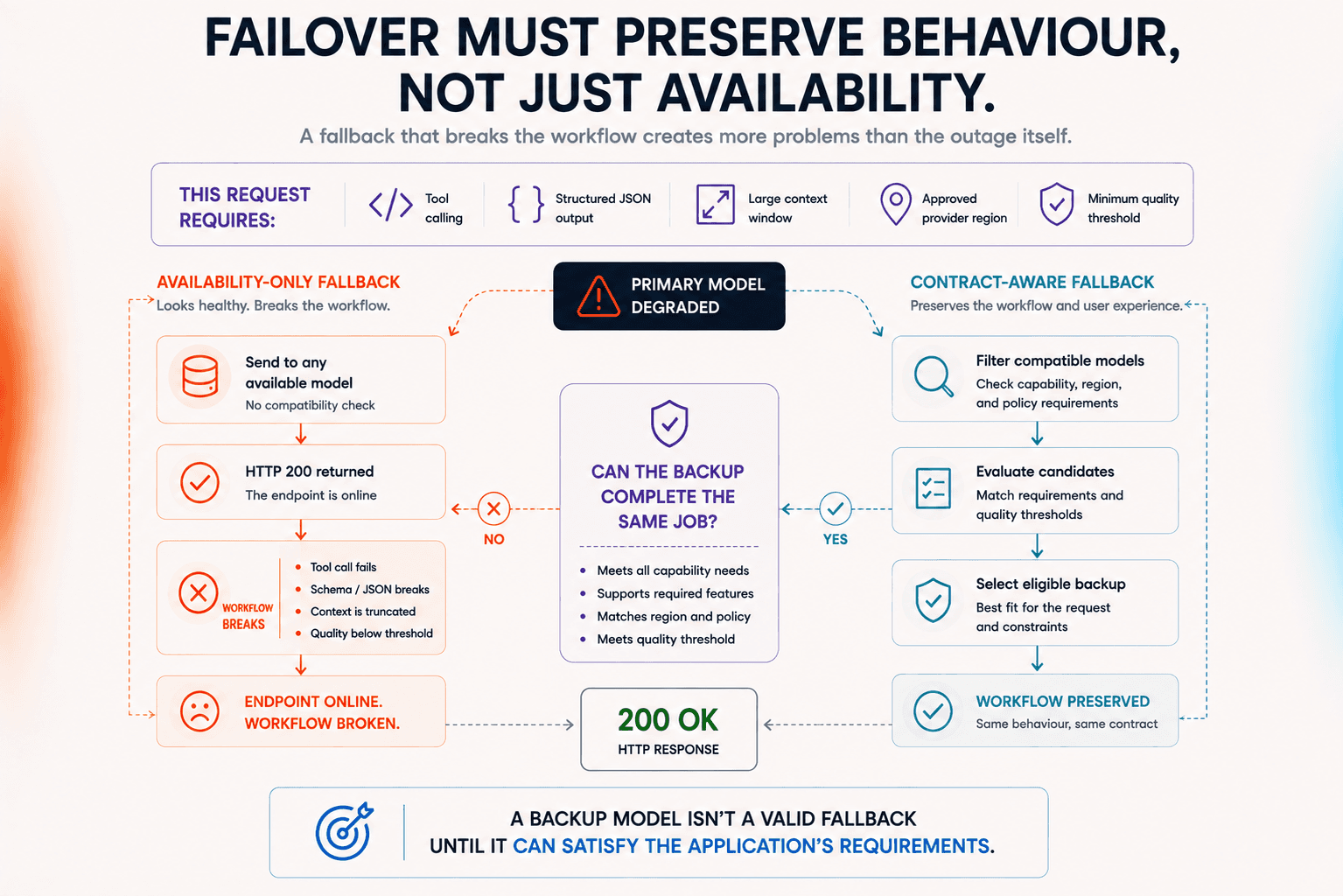
Failing over between models is not the same as sending traffic to another identical server.
A backup model must support the request your application is making. If the primary model returns structured output or calls tools, an incompatible fallback can keep the endpoint online and still break the workflow.
An AI gateway can centralize those routing rules and select backups that meet the application’s requirements. Reliability then means preserving behavior, not merely returning a response.
Our position is that a fallback is only reliable when it preserves the workflow contract.
Keeping the endpoint online has little value when the replacement model breaks the output the application expects.
4: Prompt inspection moves security closer to the model
Headers can’t reveal that a prompt contains customer data or an instruction designed to override system rules.
Those risks live inside the request body, which means the control layer needs to understand prompt content before it reaches the provider. An AI gateway can enforce those checks consistently instead of relying on every application team to implement them correctly.
5: AI observability connects model behavior to outcomes
A status code tells you whether the provider responded. It says nothing about why one request cost more than another or whether a fallback changed the quality of the result.
AI observability adds the context needed to investigate those outcomes. Teams can see which model handled a request, how much it consumed, and how performance changes over time. Without that visibility, a system can appear healthy at the infrastructure layer as the user experience deteriorates.
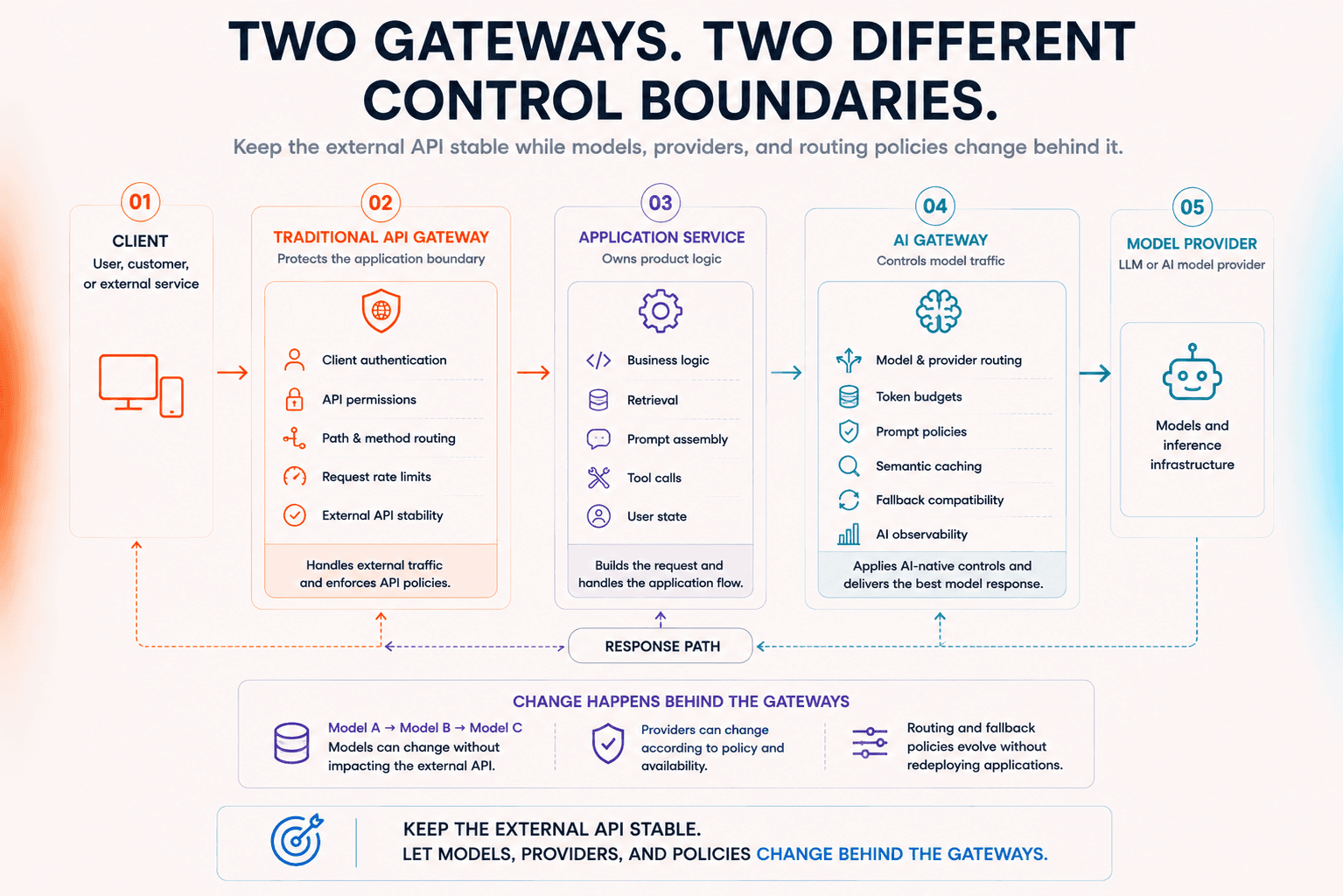
Most production architectures need both gateway layers
Production AI systems often keep both gateway layers because each controls a different boundary.
The traditional API gateway remains the front door. It authenticates the client and routes the request to the application service. The AI gateway sits behind that service, where it controls how model traffic is handled.
Take a support assistant. The API gateway decides whether the customer can access the endpoint while the AI gateway selects the model and manages what happens if the provider fails.
Trying to force both jobs into one layer usually creates custom middleware and blurred ownership.
A cleaner pattern is:
Client → API gateway → application service → AI gateway → model provider
This way, you keep the external API stable as models and routing policies change.
We prefer clear ownership between the two layers over forcing every control into one gateway.
Consolidating products isn’t the same as simplifying architecture.
Add an AI gateway when model traffic becomes a shared platform concern
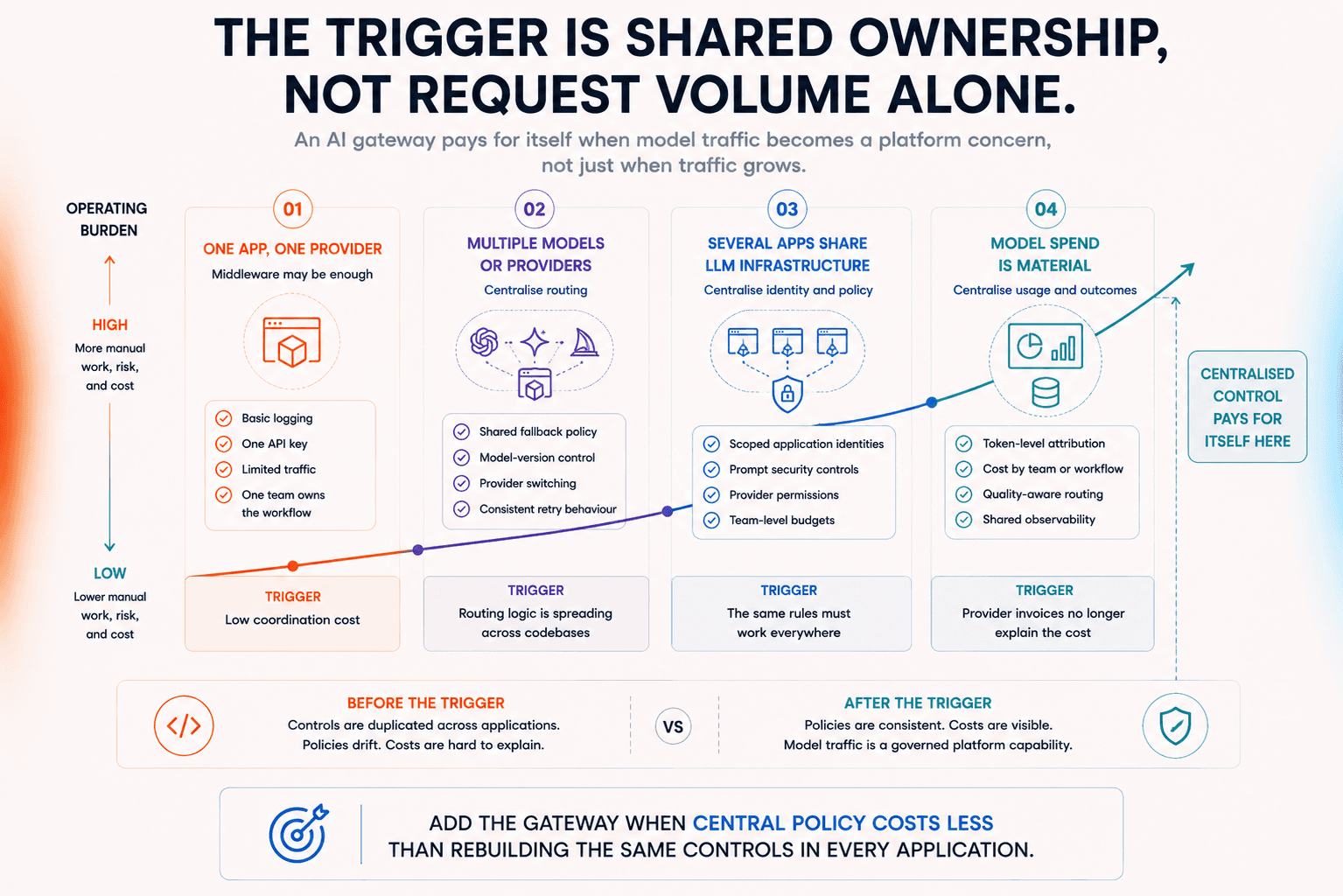
An AI gateway starts paying for itself when model traffic is no longer owned by one application team.
The trigger is rarely traffic volume alone. It’s the moment several services depend on shared models and the same controls need to work everywhere.
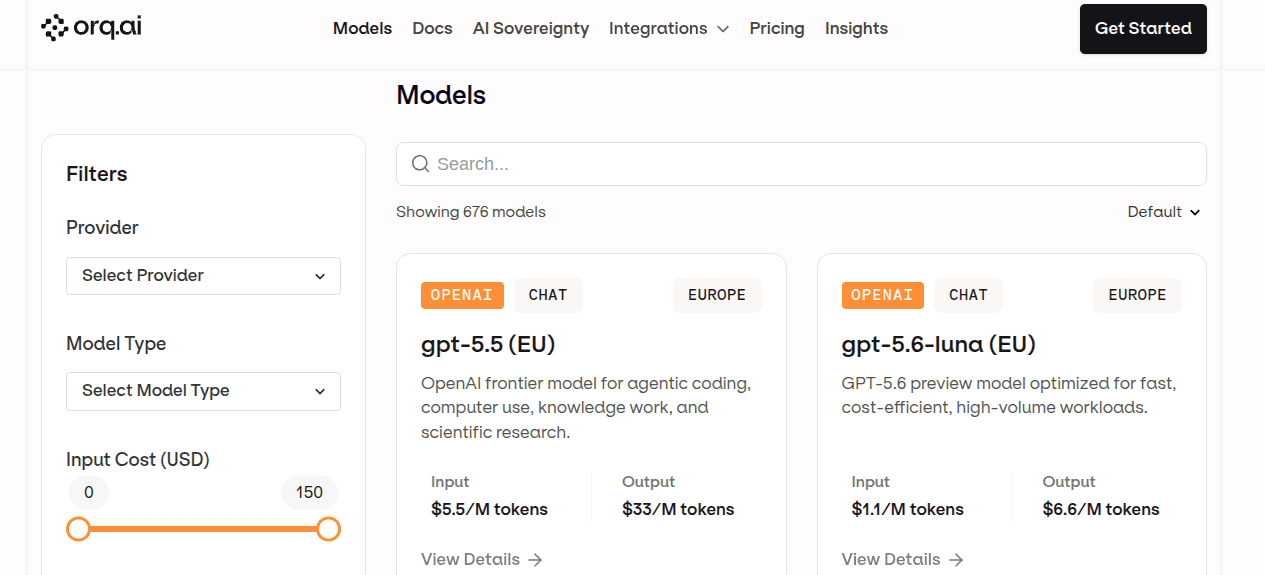
By then, custom middleware becomes duplicated infrastructure.
One provider and limited traffic: middleware may be enough
A small application calling one provider does not need another platform by default.
Basic logging and usage tracking can live in middleware until the operating burden becomes real.
Adding an AI gateway too early may create more architecture than the application needs.
Multiple models or providers: centralize routing
Routing becomes difficult to govern once every service owns its own fallback logic.
One application may retry the same provider. Another switches models after a timeout. A third pins a version that nobody else uses. An AI gateway moves those decisions into shared policy, so teams can change a route without updating every codebase.
Shared LLM infrastructure: centralize identity and budgets
One service may redact sensitive data before sending a prompt. Another relies on developer discipline.
A gateway gives enterprises one enforcement point before requests leave their environment, reducing the chance that a missing application-level check becomes an incident.
Shared LLM infrastructure: centralize identity and budgets
A shared provider key shows that the enterprise consumed tokens. It does not show which service created the cost.
Scoped identities attach each request to its owner. Budgets can then follow the team or workflow responsible for the traffic rather than sitting at provider-account level.
Material AI spend: make token usage visible
High model spend is difficult to control when it appears only as a provider invoice.
Teams need to connect usage back to the application that created it. Once that visibility exists, inefficient prompts and expensive routing choices become engineering problems that can be fixed rather than unexplained finance variances.
Orq.ai adds AI control behind your existing gateway
Orq.ai fits into the AI layer rather than replacing the infrastructure already governing client traffic. The existing API gateway continues protecting the application boundary.
That separation creates a feedback loop around routing decisions. A cheaper model is only useful if response quality holds up. A faster provider isn’t an improvement if it breaks tool calls or structured outputs.
Orq.ai helps teams evaluate those changes before deployment and monitor their effect after release.
Design for the failure your existing gateway can’t see
The wrong gateway decision rarely causes trouble on day one. It appears later, when the API remains healthy as model behavior deteriorates.
If a model change can alter the user experience without changing the endpoint, that layer needs controls of its own.
See how Orq.ai adds AI-specific control to your existing stack without replacing the gateway infrastructure already in place.
Can I use my existing API gateway for AI workloads?
Yes. It can continue protecting the external API surface and forwarding model requests, with an AI gateway added when those requests need dedicated controls.
Why can't a traditional API gateway handle LLM traffic well?
It understands transport-level signals rather than model behavior. A 200 response can still contain a costly or unusable answer, so HTTP health is an incomplete measure of AI health.
Is an AI gateway the same as an LLM gateway?
Usually. Vendors often use the terms interchangeably, though “AI gateway” may describe a broader platform that also governs agents or non-LLM services.

Sohrab Hosseini
Co-founder (Orq.ai)
About
Sohrab is one of the two co-founders at Orq.ai. Before founding Orq.ai, Sohrab led and grew different SaaS companies as COO/CTO and as a McKinsey associate.